
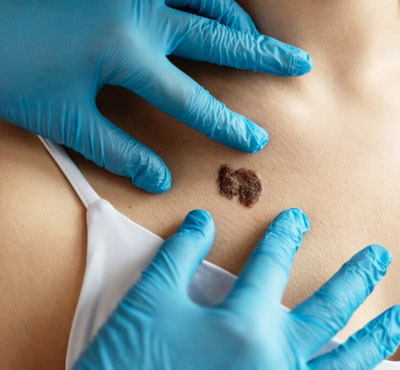
What Is Skin Cancer?
Skin cancer develops from excessive proliferation of dermis cells caused by DNA Dysregulation, which in general is due to exposure of skin to ultraviolet (UV) rays of sunlight or/and sun tanning beds. It can occur on any part of the body but is most commonly found in areas frequently exposed to the sun, such as the face, neck, hands, and arms.
Types of Skin Cancer
Basal Cell Carcinoma (BCC)
The most common, basal cell carcinoma arises from basal cells of the epidermis. It has slow growth and seldom metastasizes to other sites. BCC is usually found in the form of a glossy bump, a pink plaque or a non-healing sore.
Squamous Cell Carcinoma (SCC)
SCC originates from the squamous cells in the skin and can be more aggressive than BCC. It commonly manifests as a reddened, scaly spot, a wart-like nodule, or a bleedable/crusting sore.
Melanoma
Melanoma is the most serious form of skin cancer, originating in the melanocytes, the cells that produce pigment. Rapid infiltration into the body is also possible. Melanoma is frequently a mole or dark spot, but it can change in size, shape, or colour with time.
Rare Types
There are also rarer types, e.g., Merkel cell carcinoma, Kaposi sarcoma, and sebaceous gland carcinoma.
- Tanning Beds - Using tanning beds increases the danger of artificial UV exposure by a large margin.
- Fair Skin - Because of their reduced melanin level, those with lighter skin, hair, and eyes are especially vulnerable.
- Family History - Having a relative with skin cancer can increase the risk; genes play a part.
- Weakened Immune System - Conditions or medications that weaken the immune system can make the skin more susceptible.
- Chemical Exposure - It is possible to increase the likelihood of infection associated with exposure to specific chemicals, such as arsenic.
Symptoms of Skin Cancer
Recognizing the early signs of skin cancer is crucial. Symptoms vary depending on the type:-
- BCC - Any pearly or waxy-looking bump, flat lesion-like scar, or open sore that does not heal.
- SCC - A red, scabby lesion that is bumpy or scratched red that bleeds and will not clot.
- Melanoma - A tumour that is getting bigger, more distorted, or changing colour, usually due to the following ABCDE rule:-
A - Asymmetry B - Border irregularity C - Color variation D - Diameter larger than 6mm E - Evolving appearance
Just do not ignore any cutaneous abnormality and seek dermatological consultation if you feel any.
Preventing Skin Cancer
Prevention of harmful ultraviolet (UV) radiation effects on the skin is initiated by skin cancer prevention.
- Use Sunscreen - Utilize broad-spectrum sunscreen with an SPF of 30 or higher daily to protect the skin.
- Wear Protective Clothing - Use wide-brimmed hats, sunglasses, and clothing with UPF protection.
- Avoid Tanning Beds - Opt for safer alternatives like self-tanning lotions.
- Seek Shade - Limit sun exposure, especially in the morning and afternoon between 10 AM and 4 PM.
- Perform Self-Exams - Check your skin for any new or evolving moles or spots on a routine basis.
